

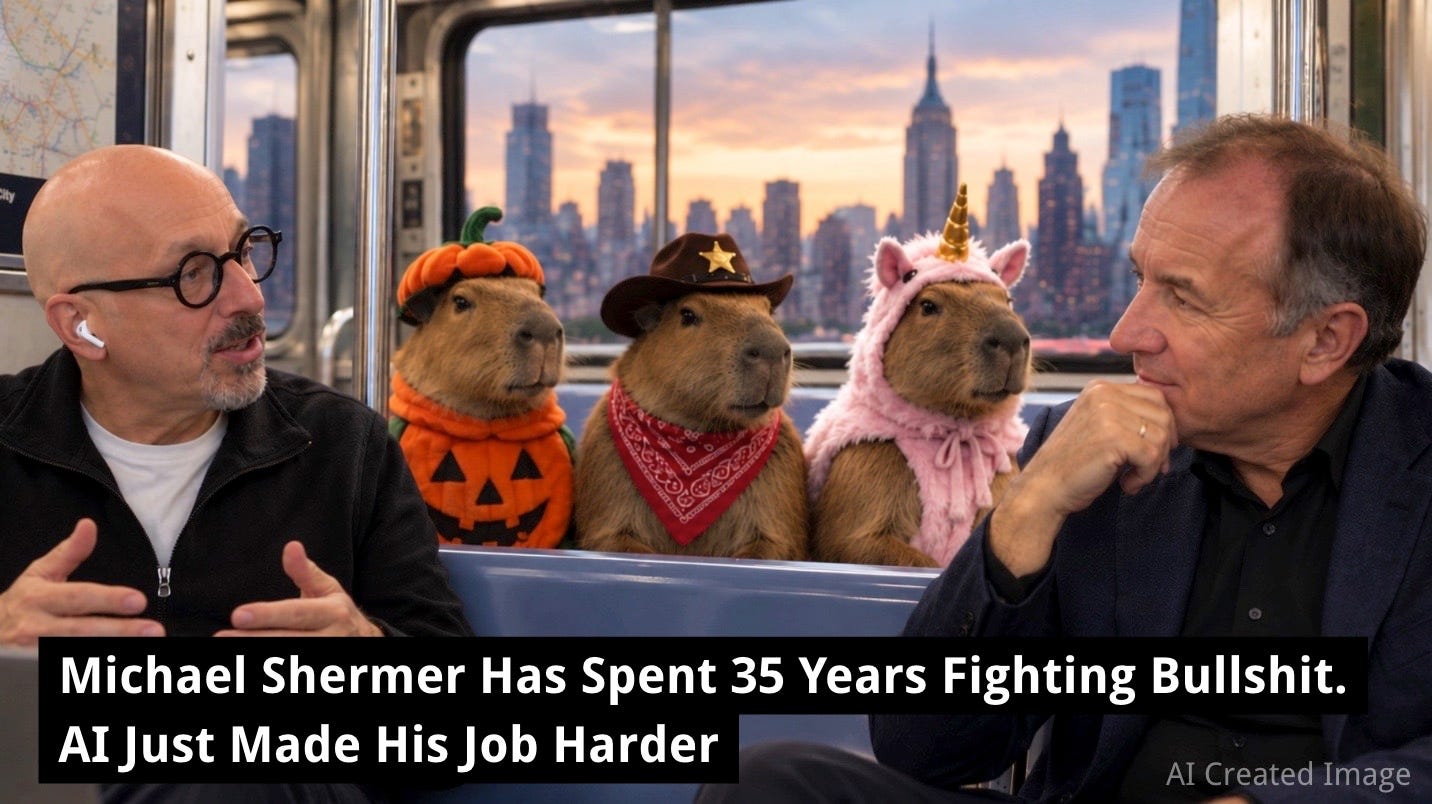
I recently sat down with Michael Shermer, the founding publisher of Skeptic magazine and author of Truth: What It Is, How to Find It, and Why It Still Matters. I jokingly called it a battle of the books. His new book is about truth. My revised book, The Future of Truth: How AI Reshapes Reality, is about what happens to truth when machines can manufacture reality.
It wasn’t much of a battle. But it was a fascinating conversation.
Shermer started Skeptic in 1992, working out of his garage while teaching at Occidental College. Back then, the skeptical movement was populated by people like James Randi and Carl Sagan, who spent their time debunking spoon-benders, psychics, astrologers, and people who claimed they could communicate with the dead.
I knew that world. I was a magician in high school. I understood the difference between a magic trick, where everyone knows they’re being fooled, and a mentalist who insists he’s actually reading your mind. One is entertainment. The other can become fraud.
Watch the conversation HERE
Shermer agreed. The fun stops when people exploit grieving families by pretending to speak with their dead relatives.
But something has changed since 1992. Back then, skepticism was a relatively small corner of the intellectual world. Today, it’s becoming an essential survival skill.
And Shermer, at 72, may be more relevant than ever.
We talked about how conspiracy theories used to spread. JFK conspiracy enthusiasts would gather in hotel rooms, print newsletters, and exchange theories with a few dozen like-minded people. Today, someone with a laptop can reach millions overnight. The internet didn’t invent conspiracy theories. It gave them distribution.
Shermer made an observation that stuck with me. The problem isn’t necessarily that people have become more conspiratorial. It’s that conspiratorial ideas now spread at extraordinary speed.
And the people trying to correct them can’t keep up.
He used to write a monthly column for Scientific American. Millions of people read it. Readers sent letters. He responded the following month. That was a perfectly reasonable pace for public debate.
Today, if he doesn’t post for a few days, he feels like he’s falling behind.
I think that’s a serious problem. We have built an information system in which the speed of publication matters more than the care that goes into it. A person who spends three days checking facts is competing with someone who can publish a hundred confident assertions before breakfast.
And now AI has entered the room.
I told Shermer about a video I saw recently. Three capybaras sitting on a New York City subway car, wearing Halloween costumes. I love capybaras. They’re strange, charming animals, and my social media feeds have figured that out. I showed the video to my wife and asked whether it was real.
She pointed out that capybaras aren’t legal pets in New York City and concluded that the video was probably AI-generated. But then I had another thought. Did I care? It was funny. It made me smile. Star Wars wasn’t real either, and I liked that.
The problem comes when the same technology that puts capybaras in Halloween costumes puts words in the mouth of a president, manufactures evidence of a crime, or creates a video of an event that never happened.
At what point do we stop believing anything we see? And what happens when people decide that information they agree with is real, while anything that challenges their beliefs must be fake?
Shermer is worried about that too. He likes community fact-checking tools, including Community Notes on X. He hopes technology companies will develop better ways to identify synthetic videos, perhaps through digital watermarks or other authentication systems. But I think the problem is bigger than detection.
The fake stuff is often more interesting than the real stuff. It’s funnier, angrier, more outrageous, more emotionally satisfying. It gives us exactly what we want to believe. And it travels faster. This became personal for me earlier this year.
I spent four years researching and writing The Future of Truth. I went back to graduate school at NYU to study truth. I worked with editors, proofreaders, and fact-checkers. The manuscript went through an extensive professional editorial process.
And still, errors made it into the published book.
A New York Times reporter discovered fabricated and misattributed quotations. The irony was obvious. An author writing about truth had published a book containing AI-related errors.
It was a painful experience. I took responsibility, undertook a detailed audit, corrected the errors, and published a revised edition. But what continues to disturb me is how the errors happened.
Imagine taking the transcript of my interview with Shermer, feeding it into an AI tool, and asking for the five best quotes. The machine produces five perfectly plausible statements. They sound like Shermer. They reflect ideas he expressed. They might even be more eloquent than what he actually said. Except he never said those exact words. That’s not editing. That’s manufacturing a quotation.
And when a fabricated quote sounds entirely plausible, it can slip past people who have spent their careers checking facts. The words look right. The ideas sound right. Nobody thinks to question whether the machine has quietly improved the source material.
Shermer had his own AI story. He recently learned that an article published in Skeptic had been entirely generated by AI. The writer was an established scientist and professional author. Shermer was stunned.
He compared it to cycling, something he loves. Why would he hire someone else to ride his bicycle? He enjoys riding it. He enjoys writing his books.
I understand that instinct. But I also think we need to distinguish between using AI as a tool and allowing AI to replace the work itself.
There is a difference between asking AI to critique your draft, asking it to help organize research, and handing it a topic and publishing whatever comes back.
Right now, we don’t have a clear, widely accepted language for those distinctions. And that matters because the economics of information are changing.
A human journalist can spend a week researching and writing one carefully reported article. An AI system can generate thousands of plausible articles in a fraction of that time. The machine doesn’t need to sleep, interview anyone, or worry about its reputation. The resulting flood of information makes careful human work harder to find. This is where Shermer’s new book becomes especially relevant.
He argues that truth isn’t simply what we believe. In science, truth means accepting a conclusion provisionally because the evidence supports it, while remaining willing to change our minds when new evidence appears. That’s a demanding standard.
It requires evidence. It requires humility. It requires admitting when you’re wrong. We talked about COVID, vaccines, public health leadership, and the difficult balance between uncertainty and decisive action. We didn’t agree on everything. I pushed back on his argument that public officials should have been more open about what they didn’t know. When you’re trying to lead millions of frightened people through a public health emergency, uncertainty has consequences too.
But we agreed that scientific understanding changes, and that acknowledging uncertainty isn’t the same as abandoning truth.
In fact, the willingness to correct yourself may be one of the most important distinctions between skepticism and ideology.
Shermer described people who refuse to respond when evidence contradicts their claims. At that point, he argued, the conversation effectively ends. If nothing could change your mind, you’re no longer investigating the truth. You’re defending a belief. That distinction matters enormously in our current political environment.
We live in a culture where admitting an error is often treated as weakness, where changing your mind is portrayed as betrayal, and where certainty is rewarded even when it’s completely unjustified.
AI makes all of that worse because it can manufacture the appearance of evidence to support almost any position. Near the end of our conversation, I asked Shermer how someone becomes a good skeptic without turning into the kind of person who questions absolutely everything and makes everyone around them miserable.
His answer was partly about temperament. He’s an optimist. But he’s also spent decades listening to people make extraordinary claims without extraordinary evidence.
He talked about what psychologists call our tendency to default to truth. Most of us believe what other people tell us because we don’t have the time or energy to fact-check every conversation. That worked reasonably well in a world where manufacturing convincing falsehoods required some effort. It works less well when machines can produce them endlessly.
I suggested that we should build a pair of smart glasses that would flash a red light whenever someone was lying to you. Shermer laughed and said somebody has probably already thought of it.
Maybe they have. But I’m not sure technology alone can solve a problem technology is accelerating. What I took away from our conversation was something more fundamental.
Shermer has spent 35 years teaching people to ask for evidence. I’ve spent the last several years studying what happens when the evidence itself can be manufactured. Those are no longer separate questions.
We need better tools, better journalism, more accountable technology companies, and a public willing to do the difficult work of distinguishing what feels true from what can actually be demonstrated. And we need to stop treating skepticism as cynicism.
A skeptic isn’t someone who believes nothing. A skeptic is someone willing to believe something when the evidence supports it, and willing to change their mind when it doesn’t. That seems like a pretty good place to start.
Because in a world where anyone can manufacture a convincing reality, the future of truth may depend less on what we can see and more on what we’re willing to question.
Michael Shermer’s book is Truth: What It Is, How to Find It, and Why It Still Matters. My book is The Future of Truth: How AI Reshapes Reality. Our conversation was recorded for the Sustainable Media Center.
