

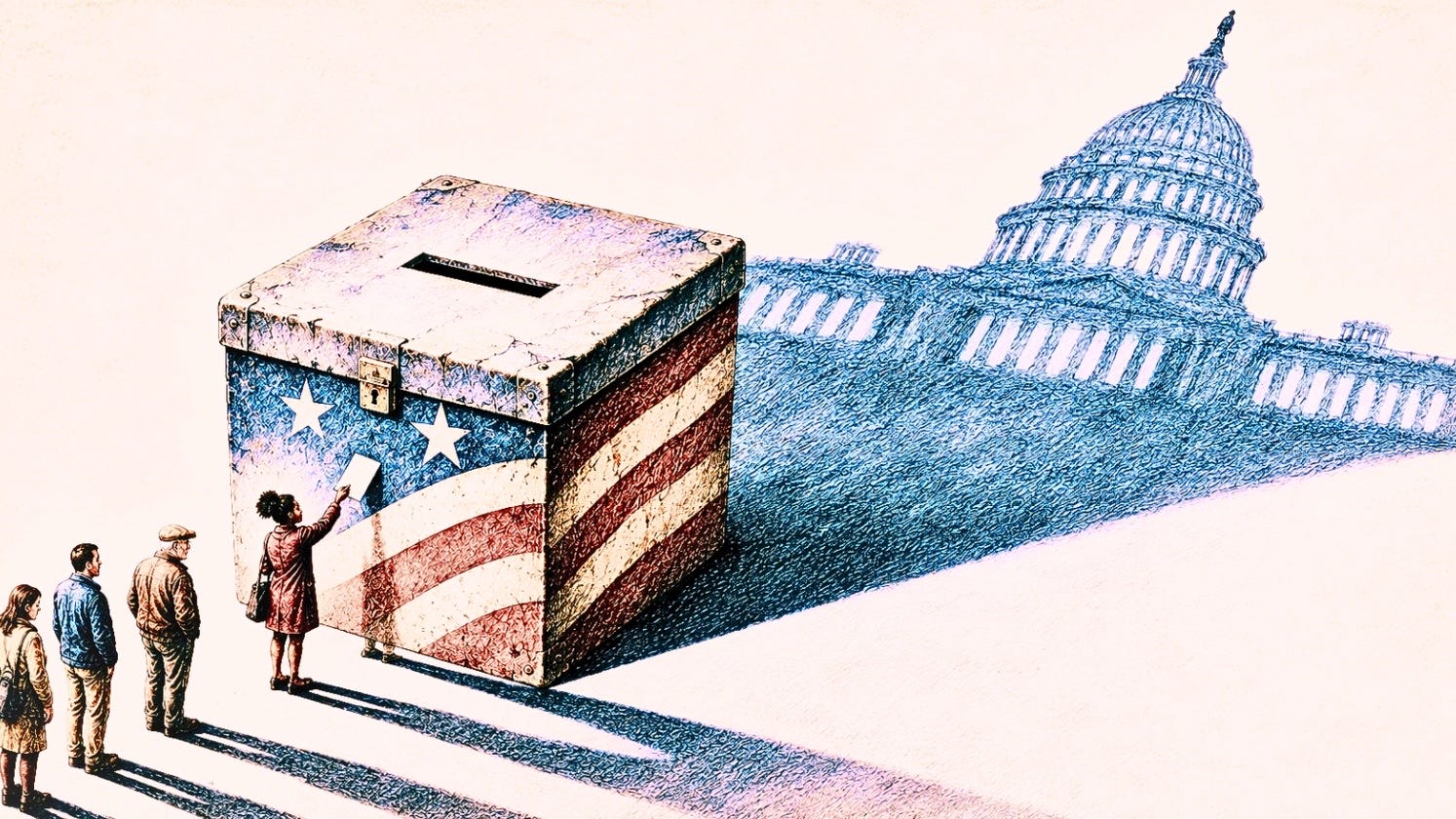
The country woke up to a Democratic House and Senate. Whatever your politics, that’s the system doing its job: voters showed up, and power moved. GenZ broke hard toward Democrats, though it didn’t grow its share of the vote. Billionaires and AI super PACs spent record sums, often on ads that never named what they were really about, and moved fewer votes than they paid for. The misinformation showed up right on schedule, mostly on X. A new Congress could finally move on kids’ online safety, an issue that has never belonged to one party. Voters in town after town said no to data centers. Here’s our take on what mattered most for Democracy.
1. The Wave
Democrats will control both chambers, CBS News projects, in an election the network says is widely viewed as a rebuke of President Trump. The party flipped Senate seats in Ohio, Iowa, South Carolina, Maine, North Carolina, Kansas and Texas, CNN reports, and Abdul El-Sayed is projected to win Michigan as the first Muslim senator in U.S. history. The AP called the House early Wednesday, and Hakeem Jeffries is now in line to become the first Black speaker, according to Forbes. Young voters drove a big piece of the swing. More than 70% of voters under 30 backed Democratic House candidates, the widest youth margin ever recorded in a national election, Tufts’ CIRCLE estimates. That included 65% of young men, CIRCLE found, a group that broke for Trump in 2024. The AP Voter Poll shows the same shift. The catch: CIRCLE puts under-30 voters at about 10% of all ballots, down from 12% in 2022. GenZ voted loudly. It just didn’t vote big.
2. Big Money, Small Returns
Forecaster Logan Phillips told Fortune this “might just be the biggest defeat for big money in politics.” Big donors wrote checks on both sides, as the Brennan Center laid out last week, but the biggest bets landed hardest. Elon Musk put more than $200 million behind Ken Paxton in Texas, and James Talarico won by about 10 points. Vivek Ramaswamy spent an estimated $36 million of his own money and lost Ohio’s governor race to Amy Acton. The AI industry had a rough night too, and much of its spending was hard to spot. AI super PACs flooded the airwaves with ads that don’t mention AI at all, The Nation observed, often through opaquely named groups. American Mission, the Republican arm of the Leading the Future network backed by OpenAI president Greg Brockman and Andreessen Horowitz, spent about $2.7 million in South Carolina, and its candidate lost to Democrat Annie Andrews in a state Trump carried by 18. The industry wasn’t speaking with one voice, either. A rival network, Public First, funded by Anthropic, backed candidates pushing for tighter AI oversight, and faced its own questions about donor disclosure, Bloomberg reported. Last week we asked where the money went. This week’s answer: not as far as its buyers hoped. The next fix is simple to say and hard to pass. Voters should be able to see who’s paying to persuade them.
3. The Misinformation Showed Up as Expected
By Election Day, NewsGuard had debunked 43 viral false claims about the midterms, spotted 511 times across 12 platforms. Twenty were about supposed fraud, and Musk’s X accounted for 62% of all sightings. The biggest one landed Tuesday: posts claiming an FBI raid in Houston had uncovered more than 20,000 “fraudulent ballots” for Democrats. PolitiFact flagged the claim, and the FBI’s Houston office said no election-related operation ever happened. Officials reported scattered voting problems, but the AP, via PBS NewsHour, found no verified malfeasance before polls closed. Counting votes is slow and boring. Lies are fast and fun. Guess which one the algorithm picks.
4. Now, About Tech and Young People
Here’s the question for SMC: what does a new Congress mean for platform accountability? Children’s online safety is the one place a federal law looks plausible, either in the lame duck or next year, PPC Land reports. The House passed its KIDS Act without a duty of care, which Sens. Marsha Blackburn and Richard Blumenthal, a Republican and a Democrat, blasted as a pale imitation of real accountability. Their KOSA passed the Senate 91 to 3 last Congress. Don’t expect a flood of tech bills, though. Seven policy experts polled by The Renovator agreed major legislation is unlikely in 2027, but said a Democratic majority means hearings, subpoenas and an end to the push to stop states from regulating AI. That matters, because states are moving: Gov. Kathy Hochul just signed the country’s strictest limits on AI chatbots that talk to minors. Protecting kids online has never been a red or blue issue. GenZ helped shape this Congress. Now it gets to hold it to its promises.
5. Not in My Backyard
The most lopsided results of the night weren’t in a Senate race. In local elections across the country, 33 measures to restrict data centers passed or were leading late Tuesday, and only one, in North Dakota, went the other way, Stateline reports. The measures ranged from outright bans to moratoriums, energy caps and requirements that voters approve new construction, in Republican and Democratic towns alike. An NBC News exit poll found 56% of voters called AI and data centers a crucial or major factor in their vote for Congress. In Pennsylvania, data centers showed up in at least 20 competitive state legislative races, Spotlight PA found, and candidates in both parties ran against them. Republican Rep. Rob Bresnahan promised in an ad that data centers won’t be forced on northeastern Pennsylvania without the people’s approval, as Inside Climate News reported for Spotlight PA. AI has a body now: land, water and power lines. And neighbors get a vote.
6. Overheard
“This election was a referendum on Trumpism. It was not about ideology. 2028 will be a referendum on Democratic leadership.” Richard Stengel, former Under Secretary of State and SMC Advisory Board Member, on Threads
“It was also the corruption. The incompetence. The tariffs... The overly aggressive deportations... The threats against enemies.” Erick Erickson, conservative radio host, via Fox News
“We are tired of being told to hate each other... Hate is predictable. Hate is boring. Hate can’t lower our energy bills.” Sen.-elect James Talarico, in his victory speech, via the Houston Chronicle
JOIN US TOMORROW: What Comes Next: An SMC Zoom Call
Community Conversation, Thursday, November 5, 11 a.m. ET
The votes are (mostly) counted. Join Sustainable Media Center to sort out what happened, what it means for GenZ, Tech and Democracy, and what we do next. None of these questions belongs to one political party, and none will be answered by a single election. Register here.
Curated and edited by Steven Rosenbaum, drafted with AI.